

 linkedin
 linkedin
31.08.2026 News
Are your PDF documents ready for the European Accessibility Act?
The European Accessibility Act (EAA) has introduced new accessibility requirements across Europe, encouraging organizations to make their digital products and services more accessible to people with disabilities. While many companies are already aware of website accessibility requirements, few realize the impact it may have on one of their most widely used communication channels: PDF documents. Ensuring PDF accessibility is becoming an important part of regulatory compliance and inclusive digital communication.
Whether used for customer communications, annual reports, brochures, forms or regulatory publications, PDFs remain an essential part of business communication. Ensuring these documents are accessible is becoming an increasingly important consideration for many organizations.
What is the European Accessibility Act?
The European Accessibility Act entered into application on 28 June 2025 and introduces new accessibility requirements, including the accessibility of digital documents that are part of the customer experience. PDF documents made available to customers or the public must be accessible and compatible with assistive technologies.
A transitional period until 28 June 2030 applies to certain products and services already on the market before 28 June 2025. Failure to comply may expose organizations to regulatory action and financial penalties under national enforcement rules.
In practice:
- Not every PDF is affected: accessibility requirements apply to PDF documents that are part of a product or service provided to customers, partners or the public. This includes documents such as product brochures, terms and conditions, user guides, invoices, bank statements and application forms.
- New documents are already concerned: PDF documents published after 28 June 2025 as part of these products or services should comply with applicable accessibility requirements.
- Existing documents have until 28 June 2030 to meet the accessibility requirements: this deadline marks the end of certain transitional periods for products and services that already existed before 28 June 2025.
What is an accessible document?
An accessible PDF is designed so that everyone, including people with disabilities, can read and navigate it using assistive technologies such as screen readers.
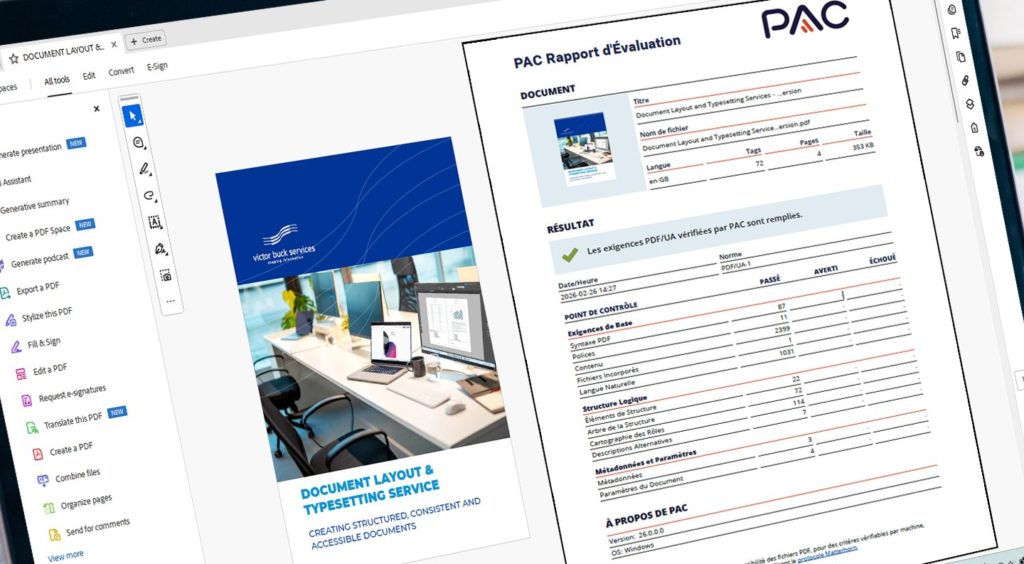
To support compatibility with assistive technologies, documents should follow recognized accessibility practices such as WCAG (Web Content Accessibility Guidelines) and PDF/UA (Universal Accessibility). This includes a logical heading structure, a correct reading order, descriptive alternative text for images, properly tagged tables and lists, and other accessibility features that enable users to navigate the document independently.
Depending on the document’s length and complexity, making a PDF accessible can take a significant amount of time: from less than an hour for a simple document to several hours for large reports containing hundreds of pages, tables, graphics or complex layouts
Why should organizations start preparing now?
Many organizations underestimate the number of PDF documents they produce and distribute every year. Marketing brochures, customer communications, annual reports, contracts, forms, policies, financial statements… these documents are often created by different departments using different tools and templates.
Reviewing and updating each of document for PDF accessibility can quickly become a significant task. Although some transitional provisions remain in place until 2030, organizations should not wait until the deadline approaches. Assessing existing documents and integrating accessibility into future document production takes time, particularly for organizations managing large volumes of PDFs.
Organizations often underestimate the effort required to make existing documents accessible. The sooner accessibility is integrated into document production, the simpler it becomes to maintain compliance over time.
Damien Goffinet, Desktop Publisher, Victor Buck Services
How Victor Buck Services can help
To help organizations address the European Accessibility Act requirements, Victor Buck Services now offers a dedicated PDF Accessibility Assessment and Remediation service.
Our specialists review and remediate your documents by applying the appropriate structure, tags, reading order, image descriptions and other accessibility features aligned with WCAG and PDF/UA best practices. Every document undergoes functional testing and quality checks before delivery.
Beyond remediation, we also provide practical recommendations to help organizations integrate accessibility into their document design and production process. Because accessible PDFs are most effective when accessibility is considered from the very beginning, this approach helps reduce future remediation efforts while improving the overall user experience.
Alongside the remediated PDF, we provide a detailed accessibility report documenting the work performed and the results of our verification process.
Not sure where to start?
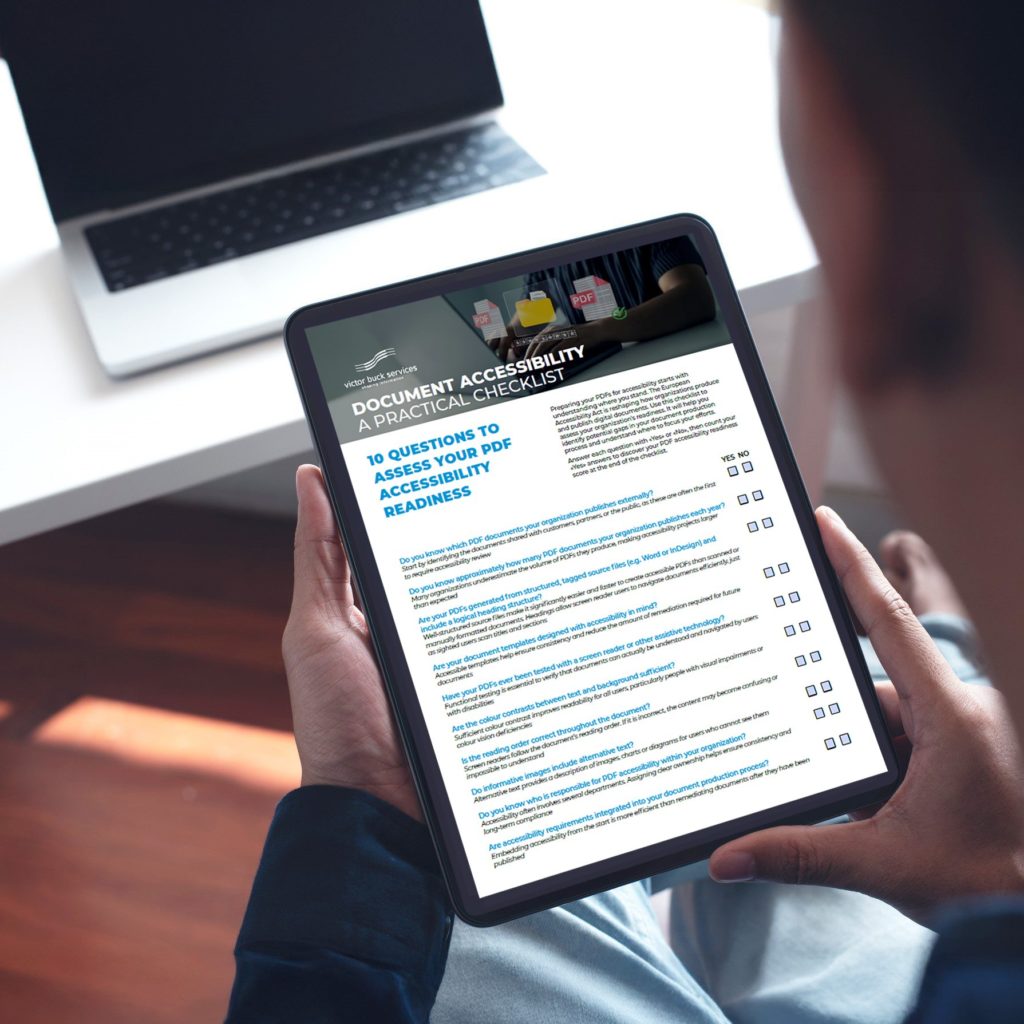
- Document accessibility checklist: assess your organization’s accessibility readiness with our 10-questions checklist. It will help you identify potential gaps in your document production process and understand where to focus your efforts.
- Get a free PDF Accessibility Check for one document: our specialists will review your document, identify accessibility issues, remediate the PDF and perform functional testing.
Accessibility isn’t a one-time project. It’s a new quality standard for digital documents, just as security, branding and regulatory compliance have become standard expectations over the years.
Ludovic Duvetter, Head of Innovation, Victor Buck Services
Share this article


 View on Google
maps
View on Google
maps (+352) 49 98 66 - 1
